
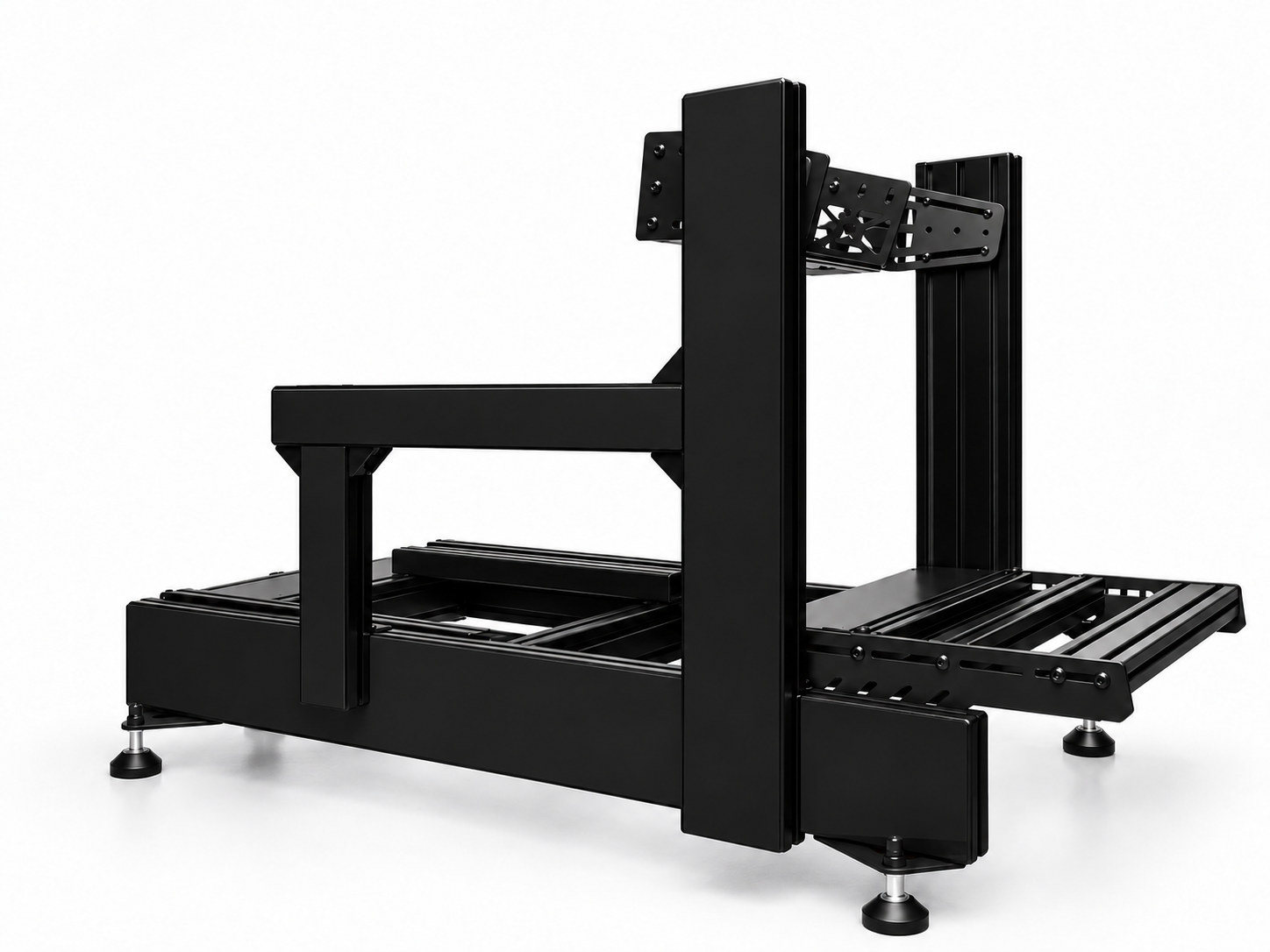

New game, same problem: your hardware either disappears… or gets in the way. Le Mans Ultimate is all about consistency, traffic awareness and doing the same thing correctly for 30, 60, sometimes 120 minutes. Comfort and stability matter more than raw force feedback strength.
Release note: Le Mans Ultimate was released Early Access Feb 20, 2024 (full release July 22, 2025)
This guide matches the game to the hardware: which cockpit makes sense, which seat style fits the driving, and how to think about monitor placement without overcomplicating it.
Key takeaways for Le Mans Ultimate
- Endurance sims punish discomfort. If you fidget in the seat, you lose consistency.
- Triples (or a well-positioned ultrawide) help with traffic awareness more than they help with lap time.
- Choose a cockpit that’s easy to add accessories to: shifter, button box, dashboards and cable management.
Wheelbase, pedals and controller choice (and why your cockpit matters)
Le Mans Ultimate will run on anything from an entry-level gear-driven wheel to a 20+ Nm direct drive wheelbase. The key is matching the cockpit to the forces you’re generating.
- Entry wheels (Logitech G29/G923, Thrustmaster T248/T300) work best when the wheel mount doesn’t bounce or flex.
- Mid-range direct drive (Fanatec CSL DD, Moza R9/R12, Asetek La Prima) benefits from a rigid 8020 cockpit so the force feedback stays clean.
- High-end direct drive (Simucube 2, Fanatec DD1/DD2, Asetek Invicta) really wants a stiff chassis and a strong pedal deck — otherwise you feel flex instead of detail.
- If you use a load-cell brake, cockpit stiffness often improves lap time more than upgrading wheel torque.
Cockpit choice: the part that makes everything else feel better
A good cockpit does two things: it keeps your wheel and pedals fixed, and it lets you repeat the same posture every session. That’s what makes any game feel more predictable — and more fun.
Rig picks from SimXPro
- X80 GT Sim Racing Cockpit – A popular profile cockpit choice: rigid enough for load-cell pedals and most direct drive wheelbases.
- XT120 GT Sim Racing Cockpit – More mass and stiffness for endurance sims where you brake hard, lap after lap.
- XT160 - Black coating – A heavy-duty platform for high-torque wheelbases, stiff pedals, and lots of accessories (button boxes, dashboards, etc.).
Seat setup: your “driving position” is a performance setting
Endurance sims are where seat choice becomes obvious. If the seat doesn’t support you, you’ll start fidgeting — and fidgeting becomes missed apexes. Go for support you can live with for long stints.
- Set seat height so your thighs are supported but you can still modulate the pedals precisely.
- Use consistent reference points: mark seat rails and pedal positions for repeatability.
- If you get shoulder fatigue, bring the wheel slightly closer instead of gripping harder.
Seat picks that pair well with this style of game
- Torq GT Seat – A supportive GT bucket for long stints and stable shoulder support.
- GT FIA Sim Racing Seat – A race-seat feel for a locked-in endurance position (great if you like a snug fit).
- Basic Leather Reclining Seat + Slider – If comfort is priority #1, a reclining seat can be surprisingly good for long sessions.
Monitor setup: the fastest “feel” upgrade after a solid rig
In endurance and GT racing, awareness matters. Triples can make traffic management feel easier, but a well-positioned single or ultrawide can still be excellent if space is limited.
Monitor stand options
- HEAVY Triple screen setup VESA 100 - 200 – Triples for peripheral vision in traffic and better spatial awareness in side-by-side battles.
- Light Triple screen setup VESA 75 - 100 – A lighter triple stand for smaller monitors (still a big immersion upgrade).
- Single screen stand tiltable - VESA 100/200 – Single screen stand if you’re space-limited (set the right height and distance first).
In-game settings worth checking (before you blame your hardware)
These settings take 5–10 minutes and usually fix 80% of the “something feels off” complaints:
- FFB detail vs strength: endurance stints reward a lighter, more informative wheel.
- Brake pedal curve: make threshold braking repeatable, not exhausting.
- Look left/right & mirror controls: map them where you can reach without letting go of the wheel.
- HUD/relative: keep traffic info visible without cluttering your braking references.
Accessories that actually make a difference
For Le Mans Ultimate, these are the add-ons that tend to improve the experience the most:
- A comfortable seat + seat slider (for long stints and sharing the rig).
- A tidy cable setup so nothing snags during long sessions.
- A monitor mount that stays aligned after bumps or adjustments.
Quick checklist before your first serious session
- Calibrate wheel rotation and pedal travel in-game (do this once, then stop chasing it).
- Set your seat distance so you can fully press the brake without locking your knee.
- Bring the monitor closer than you think, then lower it slightly so your eyes look at the horizon naturally.
- Do 10 minutes of slow laps to build muscle memory before pushing for a hotlap.
A simple SimXPro build that works (and how to upgrade it)
- Cockpit: X80 GT Sim Racing Cockpit
- Seat: Torq GT Seat
- Monitor stand: HEAVY Triple screen setup VESA 100 - 200
If you want a clear upgrade path: start by locking in your posture (seat + pedals), then upgrade rigidity (cockpit), then expand your view (monitor setup).

Share:
Horizon Chase 2 setup guide: A minimal cockpit setup that feels surprisingly good
Active seat belt tensioners: How they work and what to watch out for