
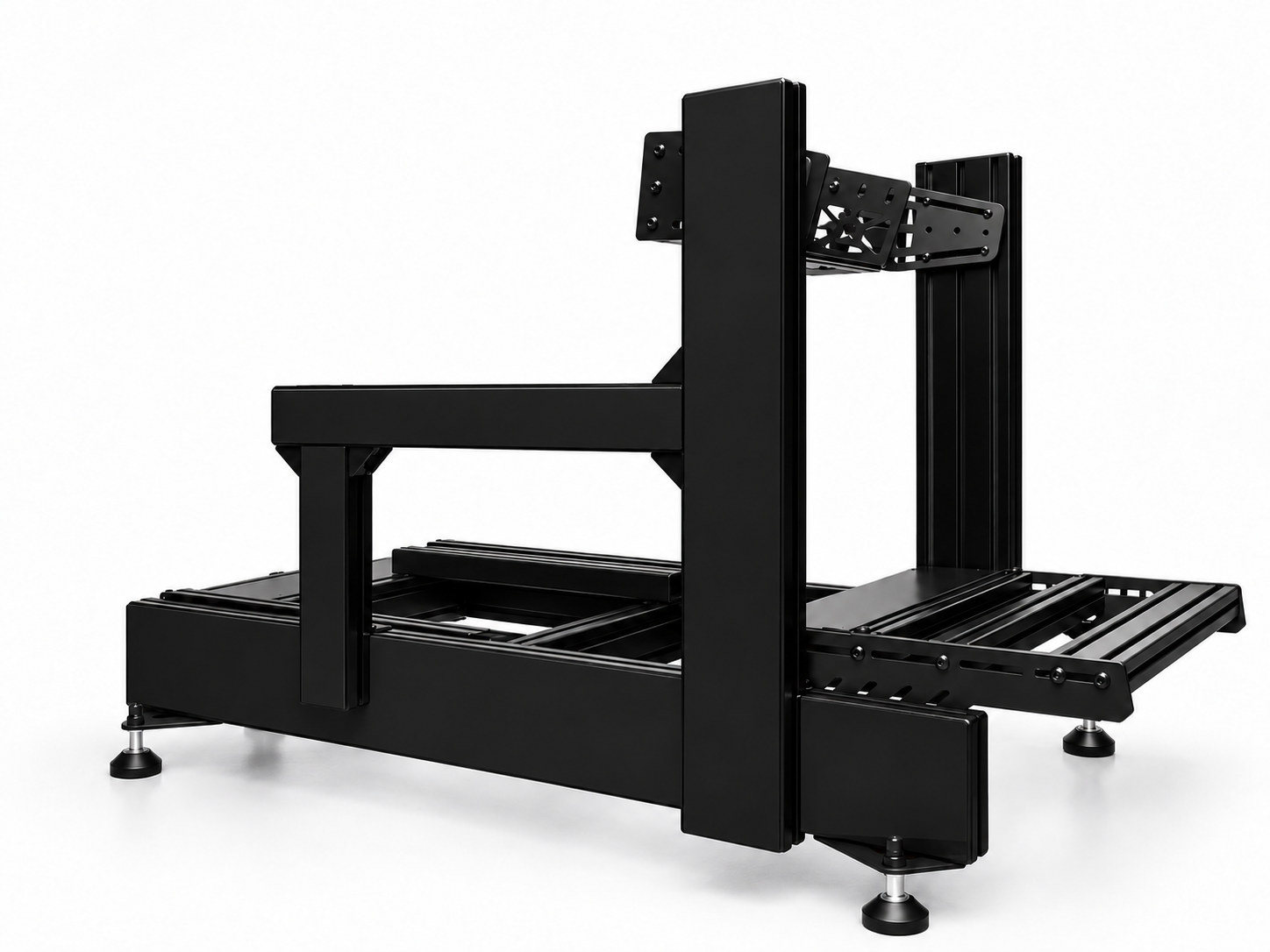

Starting with sim racing can feel overwhelming. There are many choices to make, and the right decisions early on can save you a lot of money, time, and frustration later. This guide is designed to help you make those decisions step by step, based on how people actually start sim racing and where they often run into issues. Let's build the best sim rig in 2026.
The goal is simple: help you build a no flex cockpit for load cell pedals that fits your ambitions, your budget, and your future plans.
Step 1 – Decide how serious you want to go
The first and most important question is not about brands or hardware. It is about commitment.
Ask yourself honestly whether sim racing will be a casual hobby you enjoy occasionally, or something you expect to grow into over time.
If you want to try sim racing without spending too much, it makes sense to start with more basic equipment that is easy to sell or upgrade later.
If you already know that you want to take sim racing seriously, the smartest choice is to invest early in a strong, stable rig. A solid rig can last for many years. You can always upgrade wheel mounts, pedals, or accessories later, but replacing a full cockpit is usually the most expensive mistake beginners make.
Step 2 – Choose your platform: PC or console
Your platform choice affects almost every other decision.
PC
A PC setup gives you the most freedom. You have access to the widest range of simulations, hardware brands, and configuration options. Wheelbases are often cheaper for PC, but you do need a good computer and a bit more technical knowledge to set everything up.
Console (PlayStation or Xbox)
Console setups are simpler to use, but more limited. Hardware must be compatible with your specific console. In many ecosystems, PlayStation compatibility is built into the wheelbase, while Xbox compatibility is handled through the steering wheel itself. This is important to check before buying.
If you think you might switch from console to PC later, choose hardware that allows that transition as smoothly as possible.
Step 3 – Wheelbase and pedals: where to start
For beginners, ease of use, reliability, and upgrade options matter more than raw power.
Many starters choose Fanatec because the ecosystem is broad, the products are easy to use, and there are console-compatible options available. Moza is also a popular choice, especially for PC users, offering strong performance at a competitive price point.
When it comes to pedals, think about the type of racing you want to do.
If you mainly drive Formula or GT cars, a two-pedal set is often enough.
If you want to drive rally, drift, or classic cars with an H-pattern shifter, a three-pedal set becomes important.
As you improve, pedal quality usually has a bigger impact on consistency and lap times than wheel strength.
Step 4 – Wheel mounting: front or bottom
This is a detail many beginners overlook.
Some wheelbases mount from the bottom, others from the front, and some support both. Front mounting is very popular with higher-end direct drive bases because it is extremely rigid and looks clean. Bottom mounting is still common and works well, but compatibility depends on the wheel deck design.
Always check how your wheelbase needs to be mounted before choosing a rig or wheel mount. This prevents most “it doesn’t fit” problems later.
Step 5 – Choosing the right SimXPro rig
You can use this simple guideline.
If you are just starting and do not plan heavy upgrades, the R80, X80, or GTRS are excellent choices.
If you already have experience and plan to move to a direct drive wheel and load cell pedals, but not motion, the XT120, X80, or GTRS are strong options.
If you are using or planning to use high-end hardware with 15 Nm or more and want maximum rigidity, the XT120, XT160, FRDD, XFR, or GT Pro are the best fit.
The more powerful your hardware, the more important rigidity becomes.
Step 6 – Do you need a profile pedal deck?
If you use load cell or high-force pedals, a profile pedal deck is strongly recommended.
These pedals apply a lot of force to a small surface area. A profile pedal deck eliminates flex and gives you a more consistent brake feel. Many complaints about “soft” or inconsistent braking turn out to be caused by flex in the pedal mounting, not by pedal settings.
If your pedals are mounted from the bottom, corner brackets can be used to create a solid 90-degree mounting solution on a profile deck.
Step 7 – Shifter and handbrake: now or later?
If you do not plan to use a shifter or handbrake, you do not need mounting points for them.
If you think you might want them later, it is smart to include mounting options from the start. This saves time and cost later. In some setups, extra mounting points can also add stability to the rig when using heavier wheelbases.
Step 8 – Seat choice: comfort first
A seat should fit your body, not just your setup visually.
Check whether the seat is bottom-mounted or side-mounted, whether you want a slider for adjustability, and whether it supports long sessions comfortably. A good seating position reduces fatigue and improves consistency far more than most beginners expect.
Step 9 – Monitor setup: single or triple
For a single screen, 32 to 34 inches is a popular and immersive choice.
For triple screens, 27-inch monitors are easier to place and less demanding on space and hardware. Thirty-two-inch triples offer more immersion but require more room, stronger stands, and a more powerful PC.
Curved monitors are often preferred for triple setups because they align more naturally with your field of view.
Step 10 – Monitor stands: integrated or freestanding
An integrated monitor mount attaches directly to the rig. It is more affordable and compact, but vibrations from strong wheelbases can transfer into the screen, and positioning options are more limited.
A freestanding monitor stand offers maximum flexibility and isolation from vibrations. It takes up more space and costs more, but it is the preferred choice if you want perfect positioning or use very strong hardware.
Choose carefully, as upgrading from integrated to freestanding later is not always straightforward.
Step 11 – VESA compatibility: a simple but critical check
Before buying or mounting monitors, always check the VESA pattern of your screens. Common sizes are 75×75, 100×100, and 200×200.
SimXPro offers different VESA brackets depending on the stand type. Some heavy triple stands come standard with 100×100 and 200×200 brackets. If your monitors use 75×75, additional brackets are required. Integrated and GTRS monitor mounts usually support both 75×75 and 100×100 by default.
Doing this check early avoids unnecessary returns or delays.
Advice summary
If you want to start simple and affordable, choose a basic rig, a mid-range wheel and pedals, and a single screen.
If you plan to upgrade over time, invest first in a strong SimXPro rig and a proper pedal mounting solution.
If you want maximum performance from the start, choose a high-rigidity frame, plan your mounting carefully, and keep monitors and vibrations separated.
A good sim racing setup is not about buying the most expensive parts, but about choosing components that work well together and leave room to grow.

Share:
2025’s new sim racing wave: Building a future proof cockpit (ac evo, RENNSPORT, pmr)
iRacing CPU Performance Guide: Multithreaded Physics, VR and Triple Screens