
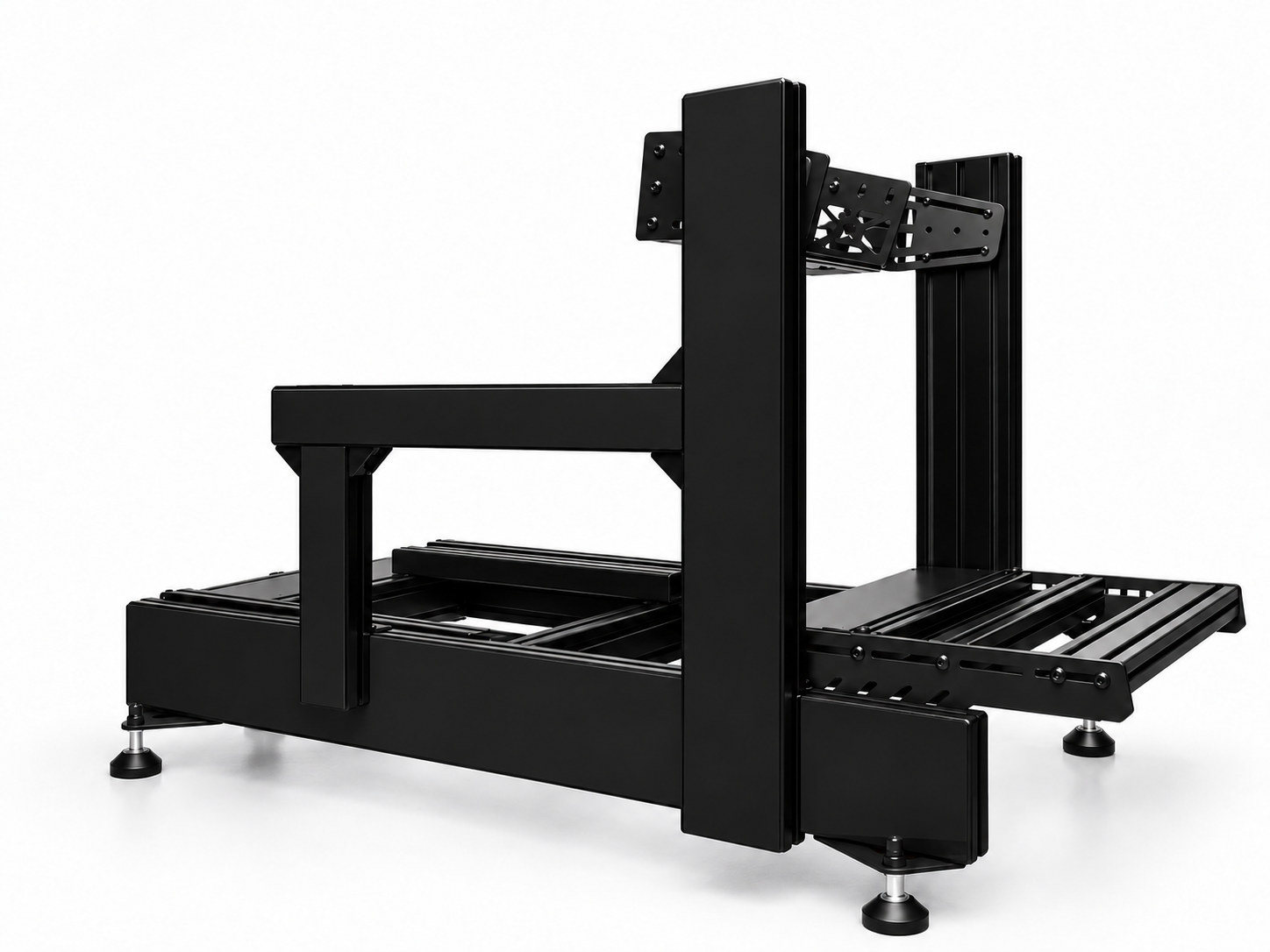

Direct drive torque is addictive. The first time you hit a kerb and the wheel talks back, you understand why sim racing can feel so close to the real thing.
But there’s a less glamorous moment every sim racer meets sooner or later: you turn in, the wheelbase fights back… and your cockpit flexes.
That’s the point where the tubular vs aluminium profile question stops being a forum debate and becomes a lap time problem.
Two rig types, one goal: remove unwanted movement
Whether it’s a budget gear-driven wheel or a high-end Direct Drive base, the job of a cockpit is the same: keep everything exactly where you set it.
If your wheel deck twists, your seat rails shift, or your pedal plate creeps under braking, you don’t just lose immersion. You lose repeatability and consistency is where confidence (and speed) comes from.
Most sim racing cockpits fall into two families:
- Tubular rigs (steel tube frames): often pre-shaped, quicker to assemble, and styled like a “real” cockpit.
- Aluminium profile rigs (8040 / 80x40 / T-slot extrusion): modular beams bolted together, designed for adjustability and upgrades.
Aluminium profile rigs: why they’ve become the default
Aluminium profile rigs look deceptively simple straight beams and brackets. The magic is that they’re basically adult Lego for sim racers.
You can move mounts by millimetres, add accessories exactly where you need them, and reconfigure the entire layout when you change hardware. That matters more than most people expect, because sim racing is rarely “buy once, done.”
What aluminium profile does best
- Rigidity where it counts: a well-designed profile chassis resists wheelbase torque and heavy braking without the “sponge” feeling.
- Near-infinite adjustability: wheel height, wheel angle, pedal distance, pedal angle, seat position—your body isn’t generic, so your rig shouldn’t be either.
- Upgrade paths: shifters, handbrakes, button boxes, bass shakers, motion, flight gear… profile rigs are made to grow.
- Accessory mounting: T-nuts and slots make it simple to mount new hardware without drilling.
- Monitor flexibility: integrated or freestanding monitor stands, wide VESA support, and clean alignment for triple setups.
Tubular rigs: the underrated strengths (and the common compromises)
Tubular rigs get dismissed online, sometimes unfairly. A well-built tubular cockpit can be strong, comfortable, and surprisingly “finished” compared to a bare profile frame.
They can also make sense when you want a clean look and you don’t plan to add many accessories.
Where tubular rigs can shine
- Fast assembly: fewer parts, less measuring, and a more guided build experience.
- Integrated design: some models feel like a single cohesive product (frame + seat + mounts).
- A neat aesthetic: tube rigs often look closer to a roll-cage cockpit.
- Comfort-first options: certain tubular frames come with very quick seat and pedal adjustments.
The trade-offs to watch
- Accessory ecosystem: adding shifters, handbrakes, button boxes, keyboard trays or motion can be harder or more expensive.
- Fine adjustment: some tube rigs have fewer micro-adjustment options than a profile rig (especially for pedal angle and wheel position).
- Upgrade ceiling: very powerful wheelbases and heavy pedal sets can expose flex at the wheel deck or pedal plate exactly where you don’t want it.
The 7 questions that decide it for you
Ignore the marketing photos for a moment. Ask these questions, and the “right” choice usually becomes obvious.
- How strong is your wheelbase (now or next)? Direct Drive torque and aggressive force feedback will quickly highlight cockpit flex.
- How hard do you brake? Load cell and hydraulic pedals reward consistency, but they demand a rigid pedal mount.
- Do you share the rig? If multiple people drive, easy adjustability (seat position, pedal distance) matters.
- How likely are you to upgrade? If you know you’ll add a shifter, handbrake, button box or motion later, plan for it now.
- How much space do you have? Some rigs (especially with triples) grow wider than expected.
- What’s your monitor plan? Single, ultrawide, triples or VR each changes how you should mount and position your screen(s).
- Are you buying a “product” or a “platform”? Tubular rigs often feel like a finished product; aluminium profile rigs behave like a platform you can evolve.
Rigidity isn’t just about material, it’s about design
“Tubular vs profile” is a useful shortcut, but stiffness comes from engineering details: the size of the mounting plates, how the joints are reinforced, and whether the load path is direct (wheelbase → brackets → frame) or indirect (wheelbase → plate → flex → frame).
Here are the three areas where a rig usually wins or loses its fight against flex:
1) Wheelbase mounting
Direct Drive bases can be mounted in different ways—bottom mount, side mount, or front mount. The stronger the wheelbase (and the more “alive” the force feedback), the more you benefit from a mount that keeps the wheelbase close to the main structure and supported on multiple planes.
That’s why many high-end rigs include reinforced brackets, thicker plates, or dedicated front-mount solutions for DD wheelbases.
2) Pedal deck stability
Pedals are where lap time lives. A soft pedal deck turns a precise brake into a guessing game—especially when you’re pushing a load cell or hydraulic brake with real force.
Look for a pedal solution that is strong, adjustable for angle, and secure under repeated braking. If the pedal plate moves, your muscle memory can’t do its job.
3) Seat mounting and posture
If the seat rails shift or the seat is mounted too high/low for your body, you’ll feel it in your lower back, knees, and shoulders. The best rigs give you enough adjustment to get a natural posture and keep it locked in.
Monitor mounting: an overlooked part of the rig decision
Your monitor setup influences your cockpit choice more than most buyers realise. Triples need width and precise alignment. Ultrawides need stable centring. And if you want the screen close to the wheelbase, an integrated mount can be a tidy solution.
Two common approaches:
- Integrated monitor mounts: bolted directly to the rig. Cleaner footprint and often easier to position close to the wheel.
- Freestanding monitor stands: the monitors are on their own frame. Great if you want to isolate screen vibration or move the rig independently of the displays.
Either can work brilliantly—the key is picking the approach that matches your space and how much vibration your wheelbase creates.
So… which should you choose?
Here’s the practical, no-drama version:
- Choose aluminium profile if you want maximum adjustability, a clear upgrade path, and a long-term platform for stronger wheelbases and pedals.
- Choose tubular if you want a clean, integrated cockpit, you like the aesthetics, and you’re happy with a more fixed configuration (or your upgrades are limited).
If you’re undecided, the tie-breaker is simple: if you plan to go Direct Drive and load cell/hydraulic braking, buy the more rigid platform first. It stops every future upgrade from being compromised.
Examples: building a profile-rig setup that can grow
One reason aluminium profile rigs are so popular is that you can start simple and expand. If you want a few reference points, here are examples from the SimXPro ecosystem (chassis, seats and monitor stands are designed to work together):
Starter platform (aluminium profile without the drama)
R80 GT Sim Racing Cockpit is designed as an entry point into aluminium profile sim racing—stable, adjustable, and with the upgrade potential you’ll want once the hobby bites.
Performance platform (rigidity + future-proofing)
GT - RS GT Sim Racing Cockpit is built around premium-grade aluminium profiles and hardened steel brackets, aimed at high-torque wheelbases and heavy braking with a future-proof ecosystem mindset.
Professional-grade strength (when you want zero excuses)
XT120 GT Sim Racing Cockpit targets maximum rigidity and adjustability. It comes with a universal front wheel mount, an extended 58 cm shifter mount, and a universal profile pedal deck as standard—exactly the kind of features that matter when your hardware gets serious.
Monitors: integrated vs freestanding
If you want your screen(s) attached to the cockpit, integrated mounts keep everything compact and aligned around the wheelbase:
- GT - RS Single monitor mount – adjustable single-screen mounting designed for the GT-RS.
- GT - RS Triple monitor mount – triple-screen mounting designed for the GT-RS (ideal if triples are in your plan).
Prefer to isolate the displays from wheel vibrations, or move the rig without moving the monitors? A freestanding solution is often the cleanest route:
- HEAVY Triple screen setup VESA 100 - 200 – a reinforced triple-screen stand with VESA options for common patterns.
- Single screen stand tiltable - VESA 100/200 – a fully adjustable single-screen stand with tilt and VESA support.
Seats: don’t treat comfort as an afterthought
A rigid rig is only half the story. If your seating position is off, you’ll fight fatigue long before you fight for lap time.
- Torq GT – a GT-style seat design aimed at stability and long-session comfort.
- Olix GP – a formula-style seat with a patented non-flexing shell (rated up to 300 kg of force).
Final thought
There’s no single “best” rig type only the rig that best matches your hardware, your space, and your upgrade path.
But if you want one piece of advice you won’t regret: buy the most stable foundation you can reasonably afford. It makes every pedal input, every steering correction, and every future upgrade feel more “real” from day one.
Drive your dream. Then build the platform that lets you do it consistently.
Related guides
- Getting started in sim racing: Choose your first wheel, pedals and cockpit
- SimXPro vs trak racer rig: A practical buyer’s guide for aluminium profile cockpits
- SimXPro vs sim lab rig: How to choose the right aluminium profile cockpit
- What is an 8020 sim rig? the aluminium profile explained in plain english
- Sim Lab P1X Pro vs Trak Racer TR160 Mk4: how to choose a 160 profile cockpit
- Sim Lab P1X Pro vs SimXPro XT160: what an endgame rig should feel like
- Trak Racer TR80S vs Sim Lab GT1 Evo: which 8040 rig is the better first upgrade
- GT Omega Prime vs SimXPro X80: profile rig comparison for strong direct drive wheels
- Playseat Trophy vs aluminium profile rigs: when a lightweight cockpit makes sense
- Cooled seat for sim racing
- Ventilated sim racing seat
- Bucket seat width guide (s/m/l/xl)
- Best sim racing seat for back pain
- Seat slider vs fixed mount pros and cons
- Side mount vs bottom mount seat brackets

Share:
27 inch vs 32 inch triple monitors for sim racing: Space, FOV and performance
Asetek la prima vs forte vs invicta: Choosing the right wheelbase tier