

Trail braking is not ‘brake later’ — it’s ‘brake smarter’. If trail braking makes the car unstable, you’re probably rushing the release or adding steering too late. This guide breaks down the most common mistakes and gives a clear fix for each.
You don’t need a perfect lap to improve — you need a repeatable process. Focus on one change, validate it, then move on.
At a glance
- Most mistakes are timing: release too fast or turn too late.
- A flex-free pedal mount makes brake release learnable.
- Your goal is to make the car boring — then make it fast.
- A stable rig helps you learn because feedback stays consistent.
- Speed comes from repeatable inputs, not heroic corners.
- Most lap time is lost in entry and early throttle, not mid-corner.
Why this matters
Most speed comes from doing simple things well: braking in a straight line, releasing smoothly, turning in with intent, and getting back to throttle early. The trick is repeatability.
Checklist before you change anything
- Can you hold and release brake pressure smoothly (without spikes)?
- Does your seating position let you brace without tensing your shoulders?
- Focus on one skill per session (brake release, apex, exits).
- Drive at 95% until you can repeat it.
- Review one replay/telemetry metric after each session.
- Pick one car/track combo and stick with it for a week.
- Use a delta or reference lap to guide practice.
A practical step by step
- Practice with a ‘long release’ approach, then shorten it over time.
- Separate the skill: brake release first, steering timing second.
- Add speed on entry first, then on exit, not both at once.
- Reduce steering rate (turn the wheel slower, earlier).
- Squeeze throttle earlier, but more gently.
- Finish with a ‘clean laps’ block to lock it in.
Rig and hardware notes
Technique improves fastest when hardware stays consistent. If your pedal deck bends or your seat slides, you’ll ‘learn’ different inputs every lap. Lock down the rig first.
Relevant SimXPro options
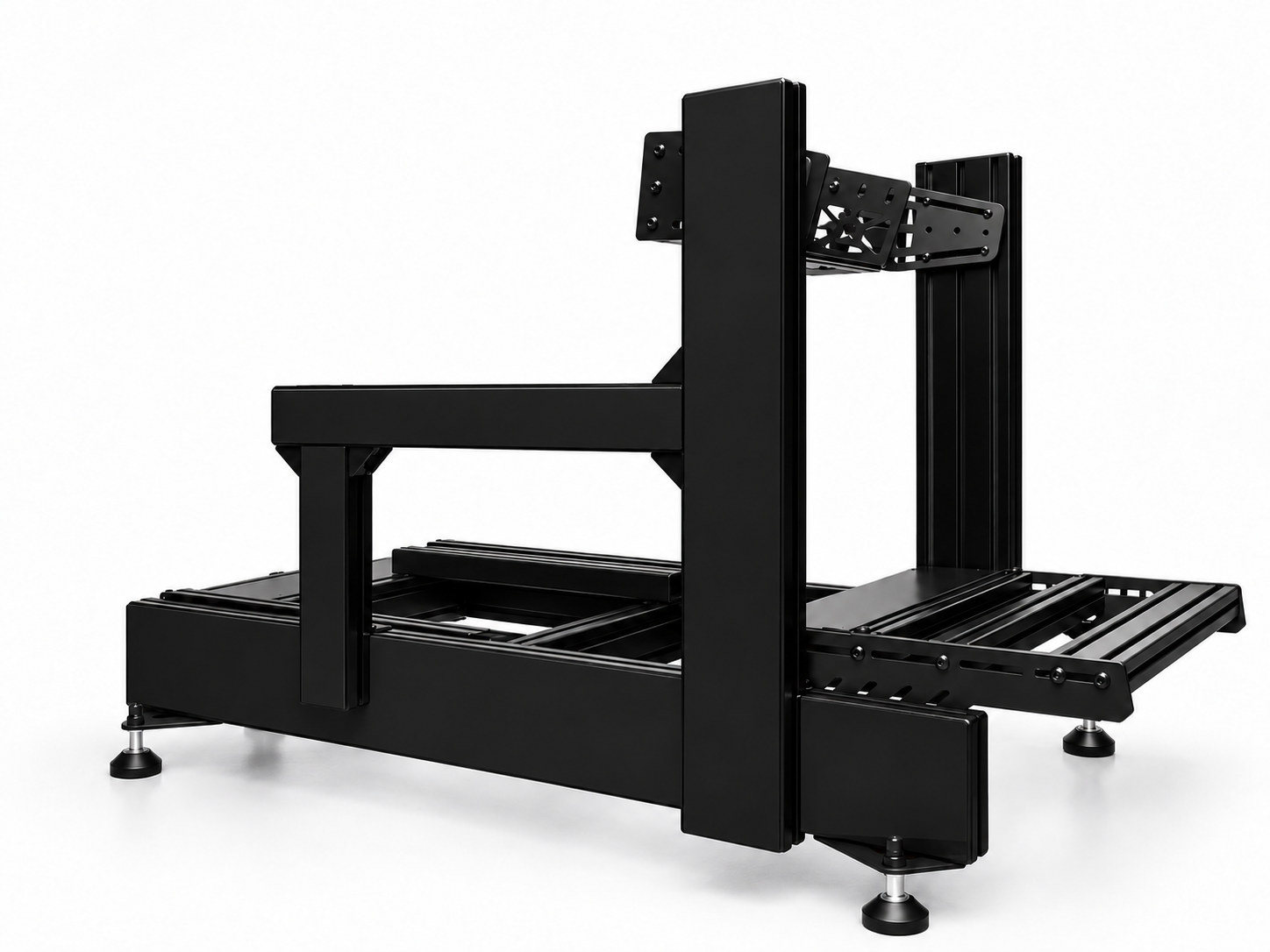
- Profile Pedal Deck 500 — A profile-based pedal deck for stiff load cell and hydraulic pedal sets.
- XT120 GT Sim Racing Cockpit — A reinforced profile rig built for high-torque wheelbases and stiff pedals.
- GT - RS GT Sim Racing Cockpit — A rigid GT-style aluminium profile cockpit with a strong upgrade path.
Common mistakes to avoid
- Staying on high brake pressure while adding lots of steering lock.
- Jumping off the brake and ‘coasting’ into the apex with no plan.
- Turning in too late and asking the tyres to do everything at once.
- Braking hard and then ‘coasting’ with no plan.
- Fixing understeer with more steering lock instead of better entry speed.
- Trying to set a personal best every lap.
FAQ
Do I need a load cell to trail brake?
It helps because pressure control is clearer, but you can still learn the timing concept on other pedals. Consistent mounting matters either way.
What should I practice first?
Braking and entry. A clean entry sets up the entire corner and makes throttle easier.
Do hardware upgrades make you faster?
They can, but only if they improve consistency. A stable rig and good pedals are usually the biggest ‘useable’ upgrades.
Why am I fast sometimes but inconsistent?
Because your inputs change each lap. Slow down slightly and make your braking points and steering rate repeatable.
Bottom line: Aim for calm confidence. Stable mounting, sensible settings and a comfortable position make everything else easier — and that’s usually where lap time comes from.
Want to go deeper? Browse our Sim Racing Guides for more buyer guides, compatibility checks and setup tips.

Share:
Throttle control tips: How to stop spinning and start rotating the car
Tyre management in sim racing: Driving style that makes tyres last