
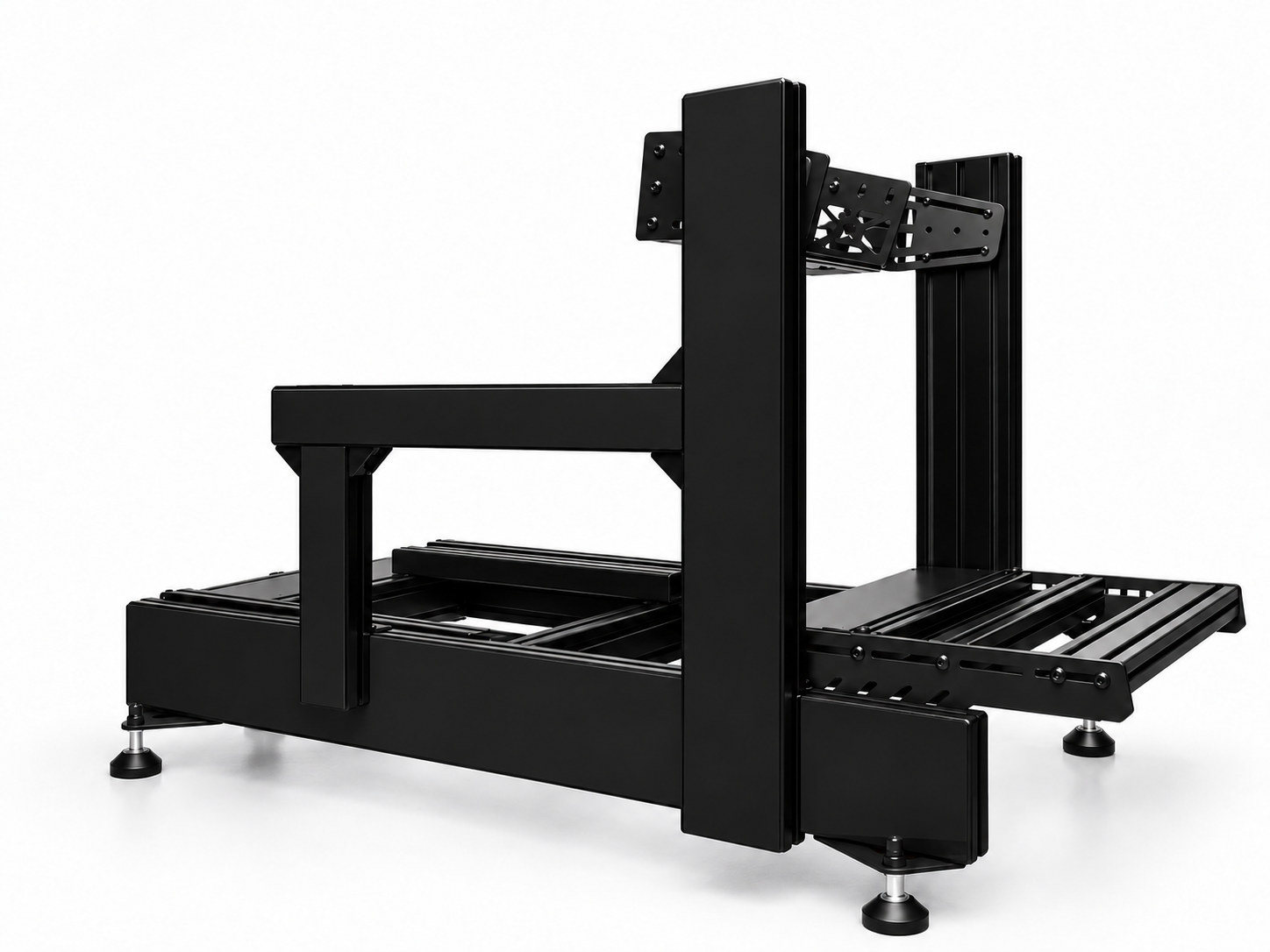

Seat mounting changes your entire driving position — not just the seat. Side mounts and bottom mounts are both common, but they influence height, recline and adjustability. Here’s how to choose the right mounting style for your rig and driving position.
Good news: most “feel” problems aren’t settings—they’re flex, seating position, or screen placement. Fix those and your lap times usually follow.
There’s no single ‘perfect’ position — but there are plenty of bad ones. The aim is neutral joints, repeatable posture and zero strain so you can focus on driving.
In two minutes
- Side mounts often give more height and angle control.
- Bottom mounts can be simpler, but may limit fine adjustment.
- Adjustability matters if you share a cockpit.
- Ergonomics is a lap-time upgrade disguised as comfort.
- If you can’t repeat your posture, you can’t repeat your braking.
- Seat height, pedal angle and wheel distance must work together.
Why rigidity changes everything
Ergonomics is what makes driving technique repeatable. If you’re stretched to reach the brake, or your shoulders are shrugged because the wheel is too high, your inputs will change as you tire. A good position feels boring — and that’s the point.
Checklist
- Do you need lower seating (formula-ish) or higher (GT with visibility)?
- Will you share the rig and need seat sliders?
- Seat fit: width at hips/shoulders and support where you need it.
- Seat-to-pedal distance that allows full brake pressure without stretching.
- Wheel height that keeps shoulders relaxed and elbows slightly bent.
- Pedal angle that lets you press the brake without lifting your heel.
- Monitor position that avoids neck strain and helps you spot apexes.
Setup recipe
- Set pedal distance and wheel height first, then choose seat height.
- Check belt pass-through alignment if you use harnesses.
- Lock it in, then only change one thing at a time.
- Set seat position first (it’s your reference point).
- Move pedals until you can brake hard without locking your knee.
- Set wheel distance so you aren’t reaching in high-speed corners.
Rig notes
Ergonomics is a system: seat, pedals, wheel and monitors. If you change one part, re-check the others. The goal is neutral joints, stable hips and relaxed shoulders — that’s where precision comes from.
Relevant SimXPro options
- Universal seat mount. Set L+R — Universal seat mounts to fit common bucket seat patterns on profile rigs.
- Universal slider — A slider kit for quick seat adjustment and sharing a rig with others.
- GT - RS GT Sim Racing Cockpit — A rigid GT-style aluminium profile cockpit with a strong upgrade path.
Avoid these mistakes
- Mounting the seat too high and raising your shoulders to reach the wheel.
- Choosing mounts that don’t match the seat’s hole pattern.
- Pedals too close: knees jammed, reduced fine control.
- Ignoring seat mounting and living with a twisted posture.
- Sitting too far from the pedals and ‘pointing’ your toes at the brake.
- Wheel too high: raised shoulders, tense hands, shaky inputs.
FAQ
Do side mounts feel more rigid?
Often yes, because they can clamp the seat more securely. But rigidity also depends on the bracket design and how it’s attached to the rig.
Do I need a bucket seat?
A bucket seat can lock you in and help consistency, but the ‘best’ seat is the one that fits your body and lets you drive pain-free.
How do I share a rig with someone else?
Seat sliders help, but you also need pedal adjustment (or marked positions). Repeatability is the goal.
What changes first: wheel or pedals?
Seat and pedals should be set together. Wheel position then follows so your upper body stays relaxed.
Bottom line: Keep it repeatable. If you can set it once and forget it — whether it’s torque, FOV, pedals or posture — you’ll drive more relaxed, learn faster and enjoy longer sessions.
Want to go deeper? Browse our Sim Racing Guides for more buyer guides, compatibility checks and setup tips.

Share:
Sequential vs h pattern shifter: Which one fits your racing (and how to mount it)
Qualifying vs race pace: How to drive one lap fast without killing consistency