
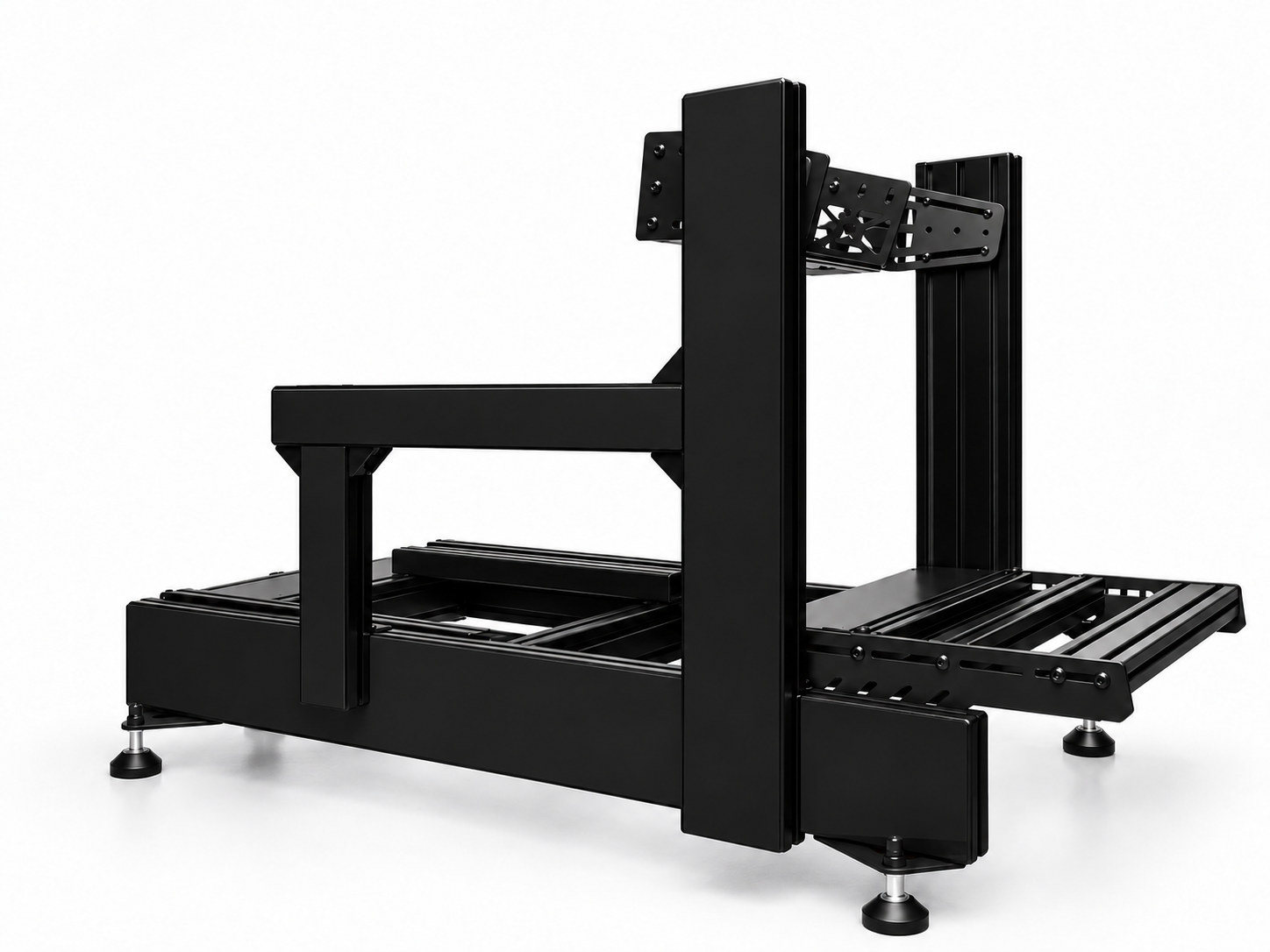

Wheel stands and cockpits exist for different phases of sim racing. One is about convenience. The other is about control.
If you’re still clamping a wheel to a desk, you already know the two big limits: movement and posture.
Wheel stand: the best ‘entry’ into sim racing ergonomics
- Pros: cheaper, easier to store, quick to set up.
- Cons: less stable under braking, seat can move, limited adjustability.
Cockpit: the upgrade that makes everything else feel better
- Pros: stable braking, consistent seating, better force feedback clarity.
- Cons: costs more, takes space, requires setup time.
The ‘time to upgrade’ signals
- You’re using load cell pedals and the chair moves.
- You’re on direct drive and feel flex in the wheel mount.
- You race long sessions and your back/shoulders hurt.
- You’re adding shifter/handbrake or triples.
A compact cockpit can still be a ‘real rig’
If space is the concern, start compact. A well-designed aluminium profile rig can fit a room and still scale with upgrades.
- Compact profile rig: SimXPro R80
- High-end GT foundation: SimXPro GT-RS
If you want the most ‘felt’ upgrade in sim racing, it’s rarely the wheel. It’s the moment everything stops moving around you.
Related guides
- Getting started in sim racing: Choose your first wheel, pedals and cockpit
- Aluminium profile vs tubular sim rigs: Which should you choose?
- Sim racing for console vs pc: What changes, what doesn’t, and what to buy
- Sim racing upgrade order: Rig vs pedals vs wheelbase (what makes the biggest difference?)
- Playseat Challenge vs Next Level Racing GT Lite Pro: choosing a foldable cockpit
- Next Level Racing F GT Lite vs Playseat Challenge: foldable rigs for small spaces

Share:
Thrustmaster T300 vs t248: Which wheel is better for your first rig?
ACC driver swaps for endurance: A simple practice plan for teams